Break Into AI Testing
Live (Zoom) • Advanced • 5 Weeks
Part of AI Career Accelerator
Break Into AI Testing
Become an AI & LLM Testing expert in 5 weeks. The only hands-on, project-based AI testing training in the world — go from manual QA to next-gen AI QA and future-proof your career.
Duration
5 Weeks
Prerequisites
1+ yrs experience in QA
Background
Good for Noncoders
Format
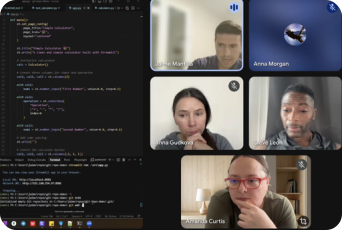
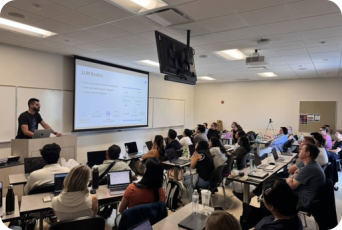
Live, Hands-On Training
Our alumni at







Upcoming
Cohort September 2026
Start Date: September 12, 2026
End Date: October 11, 2026
Duration: 5 Weeks
Format: Interactive live Zoom sessions
 Igor Dorovskikh,
  Anton Prokuda,
  Vitalii Kachalo
Pricing
$300
$2,997
or Buy Now, Pay Later with  (only for United States)
by paying, you agree to the Terms & Conditions
Course Schedule (PDT)
September 12
Saturday
10:00 AM - 2:00 PM
September 13
Sunday
10:00 AM - 2:00 PM
September 19
Saturday
10:00 AM - 2:00 PM
September 20
Sunday
10:00 AM - 2:00 PM
September 26
Saturday
10:00 AM - 2:00 PM
September 27
Sunday
10:00 AM - 2:00 PM
October 3
Saturday
10:00 AM - 2:00 PM
October 4
Sunday
10:00 AM - 2:00 PM
October 10
Saturday
10:00 AM - 2:00 PM
October 11
Sunday
10:00 AM - 2:00 PM
You Build Real Evaluation Suites From Week One.
LLM Behavior Testing
Prompt injection, jailbreaks, hallucination detection, context window limits

Evaluation Frameworks
Build automated evals with Promptfoo, custom metrics, and assertion suites

Bias & Fairness Auditing
Identify and document model bias across demographics and edge cases

Safety & Red-teaming
Adversarial testing, compliance checks, and responsible AI validation

Is this program ?
- QA Engineers and SDETs who want to stay relevant as AI reshapes software testing
- Automation Engineers looking to expand beyond traditional frameworks into AI system testing
- Manual Testers without any programming background, ready to learn from scratch, hands-on.
- Test Leads and QA Managers responsible for quality, risk, and governance in AI-powered products
- Software Engineers exploring AI-adjacent roles such as prompt engineering or AI quality
“I know how to test APIs and UIs… but AI apps feel different.”
→ This path bridges that gap.

Be Fully AI Job-Ready by Graduation
Career readiness isn't an afterthought — it's part of the program. You'll get dedicated coaching, a strategy to grow your LinkedIn presence, and real project experience you can speak to in any interview.
 LinkedIn
 Portfolio
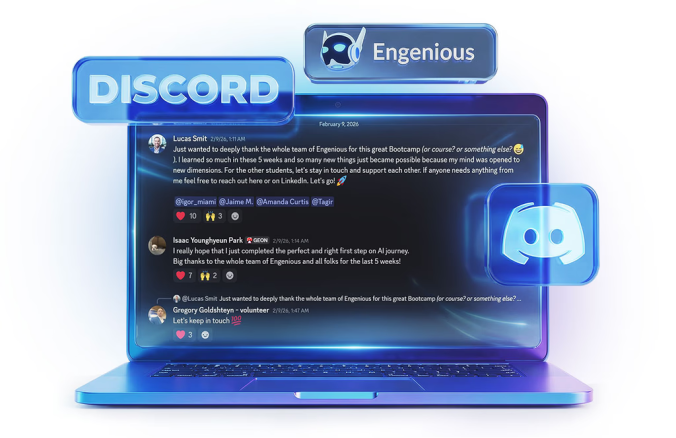
Get mentorship, job opportunities and peer support throughout Discord community, plus a network that stays with you.
 Job leads
 Community
AI isn't replacing you. It's your next career move.
Why learning is a must for Every QA in 2026?

AI Evaluation Engineering is already a specific, high-demand skill

More than 3,000+ job openings across the US

Top AI Evaluation Engineers earn over $300K/year

AI Testing Skills are in-demand in every company

You, After The Five Weeks

AI Evaluation Engineer
Portfolio-ready AI and LLM testing experience built on a real U.S. startup project with live, hands-on training.
$200,000
Expected salary
Skills
Tools
 Promptfoo
 LM Studio
 Agenta
 Arato.ai
 OpenAI API
 Anthropic API
AI Application Testing Portfolio
Hands-on artifacts covering LLM evaluation, prompt injection and jailbreak testing, multi-model comparison, and hallucination detection — built using Promptfoo, OpenAI API, Anthropic API, and LM Studio.
Proof of Work

Advanced AI Quality Engineering: Build, Evaluate, and Audit AI Systems
EnGenious University
Will I get a ?
Of course! It'll look great on your resume and LinkedIn


Your Name
Advanced AI Quality Engineering: Build, Evaluate, and Audit AI Systems
Instructors:
Igor Dorovskikh, Anton Prokuda, Vitalii Kachalo
Finished: October 11, 2026
Number of lectures: 10 / Total hours: 40
 university.engenious.io
 university@engenious.io
of our Alumni

Dennis Nikolaenko
Prompt Evaluation Engineer at Meta
“Testing AI and everything that we've been learning so far are very different. The reason why I am excited to tell you this is not because I'm super smart. It's because AI is smart and we learned how to use it. My message is if I can do it, you can do it.”

Mavis Herring
AI Quality Engineer @ WeOptimize AI
“This course built confidence. As soon as I posted that I finished the course on LinkedIn, many recruiters started approaching me.”
Hershal Walton
Gen AI Product Manager
“This course puts you in a leading frontier for new opportunities that should be coming up very soon”
Max Volovich
QA Engineering Manager @ Sirona Medical
“After this course, I not only understand how AI systems work behind the scenes, but I also feel confident leading teams building and testing them.”
We've taught to ...
Learn From

IOS SDET
10 years experience in auOriented and Protocol Oriented Programming, Design patterns, and S.O.L.I.D. principles. Anton has expertise in developing complex solutions, designing architecture, and implementing frameworks, utilities, and tools. With a unique experience in release processes and testing automation, Anton is skilled in deploying and setting
g up Continuous Integration/Continuous Delivery infrastructure. Anton's technical skills include Swift, Objective-C, AppleScript, Bash, and SQL programming languages. He is proficient in using Xcode as an IDE and has experience with CI/CD tools such as Jenkins, CircleCI, and Bitrise. Anton is well-versed in writing unit tests and UI tests using XCTest, Quick/Nimble, and SBTUITestTunnel, and is a guru with debugging tools such as Xcode Instruments, Charles Proxy, and Wireshark. In his professional experience, Anton has contributed significantly to various projects. At Engenious, he has been the driving force behind scalable test architecture and has contributed to
open-source parallel test execution solutions. Anton has also built an iOS CI/CD solution from scratch. During his time at Tinder, he played a key role in architecting iOS releases and automating the release process. He developed advanced UI tests and integrated external services for strings translation.

iOS SDET
Skilled mobile tester with the expertise in both iOS and Android platforms, where honed the skills as a manual tester in a startup environment.I have a proficiency in writing automated tests using Swift and the XCUITest framework for iOS app testing. Used this skillset to enhance the efficiency and effectiveness of the testing process, reducing the time and effort required for repetitive tasks and increasing the overall test coverage.

CEO and Founder

Test Automation Solution Architect

Sr. iOS Softwared Developer in Test
What you'll in 5-weeks
01
Week
Day 1: Cohort Kickoff + AI System Architecture
Theme: Understand what we are building and testing.
Introduction: Students begin with cohort expectations, final portfolio outcomes, and the transition from foundational AI testing into advanced AI quality engineering.
Theory: Overview of the Build → Evaluate → Audit framework. Students review the architecture of the prebuilt AI system and learn where AI failures can happen across the full application flow.
System Walkthrough: Students explore the frontend, backend/API, LLM provider, system prompt, RAG layer, tool-calling/MCP concept, logging, evaluation folder, and deployment path.
Hands-on: Students clone or access the prebuilt app repository, review the folder structure, inspect key files, review environment variables, and map the flow from UI → API → LLM → response.
End-of-Day Deliverable: AI System Architecture Notes + Initial Risk Areas.
Day 2: Run the App Locally + Extend with AI-Assisted Coding
Theme: Build enough to understand the system.
Tool Introduction: Students use Claude Code, Cursor, or another AI-assisted coding tool to understand the application codebase.
Hands-on: Students run the app locally, troubleshoot setup issues, and use an AI coding assistant to explain API routes, prompt flow, RAG flow, tool-calling flow, and error handling.
Practical Extension: Each student chooses one small improvement or change to the application, such as adding a new system prompt version, adding a policy document, improving logging, creating a new API route, or adding a debug/test mode.
End-of-Day Deliverable: Local Running App + Small Feature Extension + Architecture Map.
02
Week
Day 3: Deployment Readiness + Environment Setup
Theme: Move from localhost to a live system.
Theory: Students learn why deployed AI systems create new quality, security, and reliability risks. The session covers deployment architecture, environment separation, secrets, API keys, and common deployment issues.
Deployment Preparation: Students prepare a deployment checklist and review risks such as CORS errors, missing API keys, broken routes, timeout errors, rate limits, and environment mismatch.
Hands-on: Students prepare the app for deployment, configure environment variables, create or validate a health check endpoint or smoke test route, push changes to GitHub, and begin the deployment process.
Suggested Tools: Vercel, Render, Railway, Supabase, hosted vector database, or simple starter storage option.
End-of-Day Deliverable: Deployment Readiness Checklist + GitHub Repo Prepared.
Day 4: Live Deployment + API Smoke Testing
Theme: Deploy the system and validate it externally.
Deployment: Students deploy the prebuilt app together with their own extension and validate the public app URL.
Testing: Students test the live UI, exposed API endpoint, secrets handling, basic error scenarios, and deployment evidence.
Hands-on: Students run a live chat request, ask a RAG-based question, trigger a tool/MCP-related request, send invalid and empty requests, test long prompts, run a basic prompt injection attempt, and validate the API response structure.
End-of-Day Deliverable: Live App URL + Exposed API Endpoint + Smoke Test Evidence.
03
Week
Day 6: MCP / Tool-Calling and Workflow Evaluation
Theme: Test actions, not just answers.
Theory: Students learn how modern AI systems connect with tools and context through MCP, function calling, and API-based tool use.
Advanced Testing: The session covers tool misuse risks, permission boundary testing, tool input/output validation, and how tool calling changes the QA strategy.
Hands-on: Students test correct and incorrect tool selection, unauthorized tool requests, manipulated tool parameters, tool failure handling, tool output hallucination, missing confirmation before risky actions, and multi-step workflow failures.
Example Test Scenarios: Create support ticket, search internal policy, retrieve customer profile, summarize account history, and escalate to human review.
End-of-Day Deliverable: MCP / Tool-Calling Evaluation Report.
Day 5: RAG Evaluation and Groundedness Testing
Theme: Evaluate whether the AI system answers from the right source.
Theory: Students review RAG testing concepts, retrieval failures vs. generation failures, chunking, embeddings, source quality, groundedness, faithfulness, and citation accuracy.
Testing Strategy: Students learn how to create test cases from source documents and how to detect missing-answer failures, conflicting information, hallucination traps, unsupported claims, bad citations, and prompt injection inside documents.
Hands-on: Students build RAG evaluation test cases, test out-of-scope questions, test partial retrieval behavior, and evaluate whether the model is answering from the correct source of truth.
Suggested Tools: Promptfoo or Agenta, manual test sheet, source-of-truth document, live app API.
End-of-Day Deliverable: RAG Evaluation Test Set + Groundedness Findings.
04
Week
Day 7: Red Teaming the Live AI System
Theme: Find failures before users or attackers do.
Theory: Students review AI red teaming fundamentals, OWASP LLM and agentic AI risks, prompt injection, jailbreak attempts, unsafe tool usage, memory/context manipulation, policy bypass, access-control issues, and cascading failure scenarios.
Hands-on: Students run direct prompt injection attempts, indirect prompt injection through retrieved content, role manipulation, system prompt extraction, tool misuse attempts, unauthorized data access attempts, business rule bypass tests, and multi-turn attacks.
End-of-Day Deliverable: Red Team Findings Log + Initial Risk Classification.
Day 8: Observability and Post-Deployment Monitoring
Theme: Use traces and monitoring as testing evidence.
Theory: Students learn AI observability concepts and why traces, logs, metrics, scores, latency, cost, token usage, retrieved context, tool calls, errors, session IDs, and evaluation scores matter for quality engineering and audit evidence.
Tool Exposure: Students review Langfuse, Arato-style observability, application logs, and evaluation outputs from Promptfoo or Agenta.
Hands-on: Students capture and review traces for successful responses, hallucinated responses, failed tool calls, RAG retrieval issues, prompt injection attempts, slow responses, and API errors.
End-of-Day Deliverable: Observability Evidence Pack + Monitoring Findings.
05
Week
Day 10: Final Audit Presentation and Portfolio Packaging
Theme: Communicate like an AI Quality Engineer.
Final Optimization: Students finalize their audit report, prepare their portfolio presentation, and practice explaining technical findings to non-technical stakeholders.
Career Preparation: Students learn how to discuss the project in interviews and position their work on LinkedIn, resumes, and professional portfolios.
Hands-on: Students present the system they tested, explain what they built or extended, summarize what they evaluated, share the most important risks they found, show what observability revealed, recommend controls, make a release readiness decision, and reflect on key lessons learned.
End-of-Day Deliverable: Final AI Quality Audit Portfolio.
Day 9: AI Risk Scoring and Audit Report Creation
Theme: Turn test results into risk-based audit evidence.
Theory: Students learn the difference between a bug, defect, risk, and control. The session introduces OWASP/AIVSS-style risk thinking and explains how agentic AI systems can amplify risk.
Audit Preparation: Students map findings to categories such as tool misuse, access control, RAG hallucination, prompt injection, memory/context manipulation, untraceable decisions, poor observability, and unsafe deployment behavior.
Hands-on: Students build a risk register, assign severity ratings, link screenshots, traces, logs, or reports as evidence, recommend controls, and make a release readiness decision.
End-of-Day Deliverable: AI Risk Register + Draft Audit Report.
You Won't Find Anywhere Else
Lifetime Community Access

Join our Discord community with 1000+ QA professionals.
Ongoing support from instructors and alumni.
Regular follow-up sessions and career guidance.
Recorded Sessions
All sessions recorded and can be accessed up to for 1 year.
Review program materials and session recording anytime.
Never miss important concepts.
What's ? Even More

Minimum system

macOS:
Processor: Apple Silicon M1, M2, M3 or M4
Memory: 16 GB RAM (or higher)
Storage: 30 GB free SSD space
Note: Mac OS systems without an M chip are not supported

Windows:
Processor: Intel Core i5 / i7 or AMD Ryzen 5 / 7
Memory: 16 GB RAM (or higher)
GPU: Dedicated GPU with ≥ 6 GB VRAM (e.g., NVIDIA RTX 2060 / 3060)
Storage: 30 GB free SSD space
Click the link below this FAQ to apply for the next cohort.
Submit your application and confirm your eligibility — only 30 seats per Advanced cohort are available. Early applicants receive priority for personalized feedback and project pairing.
Final list is not set but students can expect to work with tools and platforms such as:
- Claude Code, Cursor, or another AI-assisted coding tool
- GitHub
- Vercel, Render, Railway, or similar deployment platforms
- Supabase or a hosted vector database
- PromptFoo or Agenta
- Langfuse, Arato-style observability, or application logs
- Live app APIs and manual test sheets
The exact tools may vary by cohort, but the goal remains the same: students learn how to test and audit a real AI system using professional AI quality engineering workflows.
The training is a 5-week long training. It includes 10 lectures (40 hours). Classes are held on weekends, Saturdays and Sundays from 10.00 am to 2.00 pm PST
💻 Windows
✅ Windows 10 (64-bit) or newer
✅ Intel i5 (8th Gen +) / AMD Ryzen 5 +
✅ 8 GB RAM (min), 16 GB recommended
✅ 20 GB free storage
✅ Node.js v18+, Python 3.8+, VS Code, Git (Docker optional)
✅ Chrome or Edge browser
✅ Stable 10 Mbps+ internet + webcam
🍏 macOS: macOS Monterey (12+) or newer
✅ Apple M1/M2 chip or Intel i5 (2018 +)
✅ 8 GB RAM (min), 16 GB recommended
✅ 20 GB free storage
✅ Homebrew, Node.js v18+, Python 3.8+, Docker (optional)
✅ Chrome or Safari browser
✅ Reliable 10 Mbps+ connection + webcam
💡 Tip: Dual-monitor setups improve productivity for labs and evaluations.
The course is practical because students work through a complete real-world workflow:
Build: Understand and extend a real AI system.
Evaluate: Test the deployed system across RAG, API, MCP/tool calling, red teaming, and observability.
Audit: Convert findings into risks, controls, release readiness decisions, and professional audit evidence.
This gives students more than theory. It gives them a complete project story they can explain clearly.
This course can support students preparing for roles or responsibilities related to:
- AI Quality Engineer
- AI Tester
- LLM QA Engineer
- QA Engineer working with AI products
- Test Automation Engineer moving into AI systems
- AI Red Teaming Analyst
- AI Risk and Governance Analyst
- AI Product QA Specialist
- Software Tester transitioning into AI quality
The course is especially useful for professionals who want to show proof that they can test more than simple prompts. Students learn to evaluate deployed AI systems across architecture, API behavior, RAG, tool calling, red teaming, observability, and risk.
Yes, we have 2 main requirement for the Advanced Bootcamp:
- Finish the "Break Into AI Testing" Bootcamp
- Have AI Testing experience by:
- Competing Stella Foster AI Startup Internship
- Applying your skills in your job for a minimum of 3 months
Just as before, no programming background is needed.
Yes, currently available for U.S. applicants and can be available in other regions for USD payments.
During checkout, you can select a payment plan through Stripe’s Klarna interface, allowing you to spread tuition into manageable installments.
This course is for students who already understand the basics of AI testing and want to move into more advanced, real-world AI quality engineering. It is a strong next step for graduates of the first Engenious University AI Testing course, QA engineers, test automation engineers, software testers, and technical professionals who want hands-on experience testing deployed AI systems.
The first course focuses on AI and LLM testing foundations, PromptFoo, red teaming basics, tool exploration, and career positioning. This advanced cohort goes further by helping students work with a real AI application, extend it, deploy it, evaluate it, and audit its risks.
The goal is to help students move from learning AI testing concepts to practicing AI quality engineering on a real system.
Students will follow the professional workflow:
Build the system. Evaluate the behavior. Audit the risk.
By the end of the course, students will understand how to test AI systems across architecture, deployment, RAG behavior, APIs, MCP/tool calling, red teaming, observability, monitoring, risk scoring, and audit reporting.
This course is best for students who already have a foundation in AI testing, LLM behavior, prompt evaluation, hallucination testing, and red teaming basics.
Students who completed the first Engenious University AI Testing course will be especially prepared because the advanced cohort builds on topics such as PromptFoo, red teaming, AI testing tools, AI vulnerabilities, and career positioning.
assertions, PromptFoo, red teaming concepts, bug reporting, tool exploration, LinkedIn optimization, and interview preparation.
This advanced course is more project-based. Instead of only learning how to test prompts and models, students work with a real prebuilt AI system. They inspect the architecture, run it locally, make a small extension, deploy it live, test the UI and API, evaluate RAG and tool-calling behavior, run red-team tests, review observability data, and prepare a final AI quality audit portfolio.
The course follows a clear 5-week structure:
Week 1 — Build: Architecture walkthrough and local app setup
Week 2 — Build: Deployment preparation and live API smoke testing
Week 3 — Evaluate: RAG evaluation and MCP/tool-calling evaluation
Week 4 — Evaluate: Red teaming, observability, and monitoring
Week 5 — Audit: Risk scoring, audit report creation, final presentation, and portfolio packaging
This structure helps students move through the same workflow used in professional AI quality engineering: understand the system, test the behavior, document the risk, and communicate the findings.
Yes. The final project is the Final AI Quality Audit Portfolio. Students present the system they tested, explain what they built or extended, summarize what they evaluated, share the most important risks they found, show what observability revealed, recommend controls, make a release readiness decision, and share key lessons learned.
Yes. The final part of the course focuses on communicating like an AI Quality Engineer. Students prepare a portfolio presentation, practice explaining findings to non-technical stakeholders, review how to talk about the project in interviews, and refine LinkedIn and portfolio positioning.
The goal is for students to leave with practical experience and concrete artifacts they can confidently discuss in career conversations.
Still have questions?
Not sure if this program is right for you? Need help choosing the best path or want to understand the curriculum better
Our AI assistant is here to help — fast, friendly, and available anytime.
Ask AI CAREER ASSISTANT
100% money back guarantee
If you're not satisfied by Week 1, claim a full refund, no questions.
Seats are limited to 50 registrants. Secure your spot today.
Ready to begin your ?
The future of QA isn't about choosing between Selenium or Playwright - it's about Mastering Prompt Engineering, LLM Testing and AI Debugging.